e-KHOOL Corporate LMS
Research-Driven
Artificial Intelligence
Our integrated platform centralizes operations efficiently for college networks across cities or regions facing complex management of student data, academics, libraries, and digital learning.
Published in:World ScientificSpringer NatureIOS PressSAGE
Publications

Scientific Research
Scientific Research Behind e-KHOOL Corporate LMS
At e-KHOOL, innovation is driven by scientific research. Unlike conventional Learning Management Systems that rely solely on feature-based development, e-KHOOL Corporate LMS has evolved through a continuous programme of peer-reviewed research in artificial intelligence, educational data mining, learning analytics, deep learning, recommendation systems, and predictive learning technologies.
Between 2022 and 2026, research associated with the e-KHOOL platform has been published in internationally recognized journals and conferences, including World Scientific, Springer Nature, IOS Press, and SAGE Publications. These studies investigate intelligent course recommendation, learner behaviour analytics, sentiment-aware learning, performance prediction, adaptive learning, and enterprise learning optimisation using AI-driven methodologies.
The findings from this research programme have directly influenced the design and continuous enhancement of e-KHOOL Corporate LMS, enabling organizations to deliver personalized, data-driven, and measurable learning experiences for employees and enterprise teams.
Research Domains
Research Areas Powering e-KHOOL AI
The artificial intelligence capabilities of e-KHOOL Corporate LMS are supported by research in the following domains:
- 01Artificial Intelligence for Enterprise Learning
- 02Learning Analytics and Educational Data Mining
- 03Intelligent Course Recommendation Systems
- 04Deep Learning and Neural Network Models
- 05Employee Performance Prediction
- 06Behavioural Learning Analytics
- 07Sentiment-Based Learning Recommendation
- 08Adaptive Learning Technologies
- 09Hybrid Machine Learning Optimisation
- 10Learning Environment Evaluation
Research Domains
Peer-Reviewed Research Supporting e-KHOOL
Research
Translating Research into Enterprise Learning Innovation
The outcomes of these research studies have been incorporated into the continuous development of e-KHOOL Corporate LMS to provide intelligent enterprise learning capabilities, including:
By combining peer-reviewed research with practical enterprise deployment, e-KHOOL Corporate LMS delivers an intelligent learning ecosystem that is scientifically validated, scalable, and designed to support digital workforce transformation.
- AI-powered personalised learning paths aligned with employee competencies and organisational goals.
- Intelligent course recommendations generated from learner behaviour, interaction history, and competency requirements.
- Predictive learning analytics to identify skill gaps, training effectiveness, and employee performance trends.
- Behavioural analytics that transform learning data into actionable business intelligence for learning administrators.
- Adaptive learning experiences enhanced through deep learning, sentiment analysis, and recommendation algorithms.
- Continuous optimisation of enterprise training programmes using evidence-based artificial intelligence techniques.
Research Impact
Research Impact at a Glance
International Publishers
World Scientific, Springer Nature, IOS Press, SAGE Publications
Core AI Research Areas
Learning Analytics, Deep Learning, Recommendation Systems, Sentiment Analysis, Educational Data Mining
Product Integration
Research outcomes incorporated into e-KHOOL Corporate LMS features
Peer-Reviewed Research
AI Built on Peer-Reviewed Research
Unlike conventional learning platforms, e-KHOOL Corporate LMS is supported by a continuous programme of peer-reviewed research in Artificial Intelligence, Learning Analytics, Educational Data Mining, Deep Learning, Course Recommendation, and Performance Prediction.
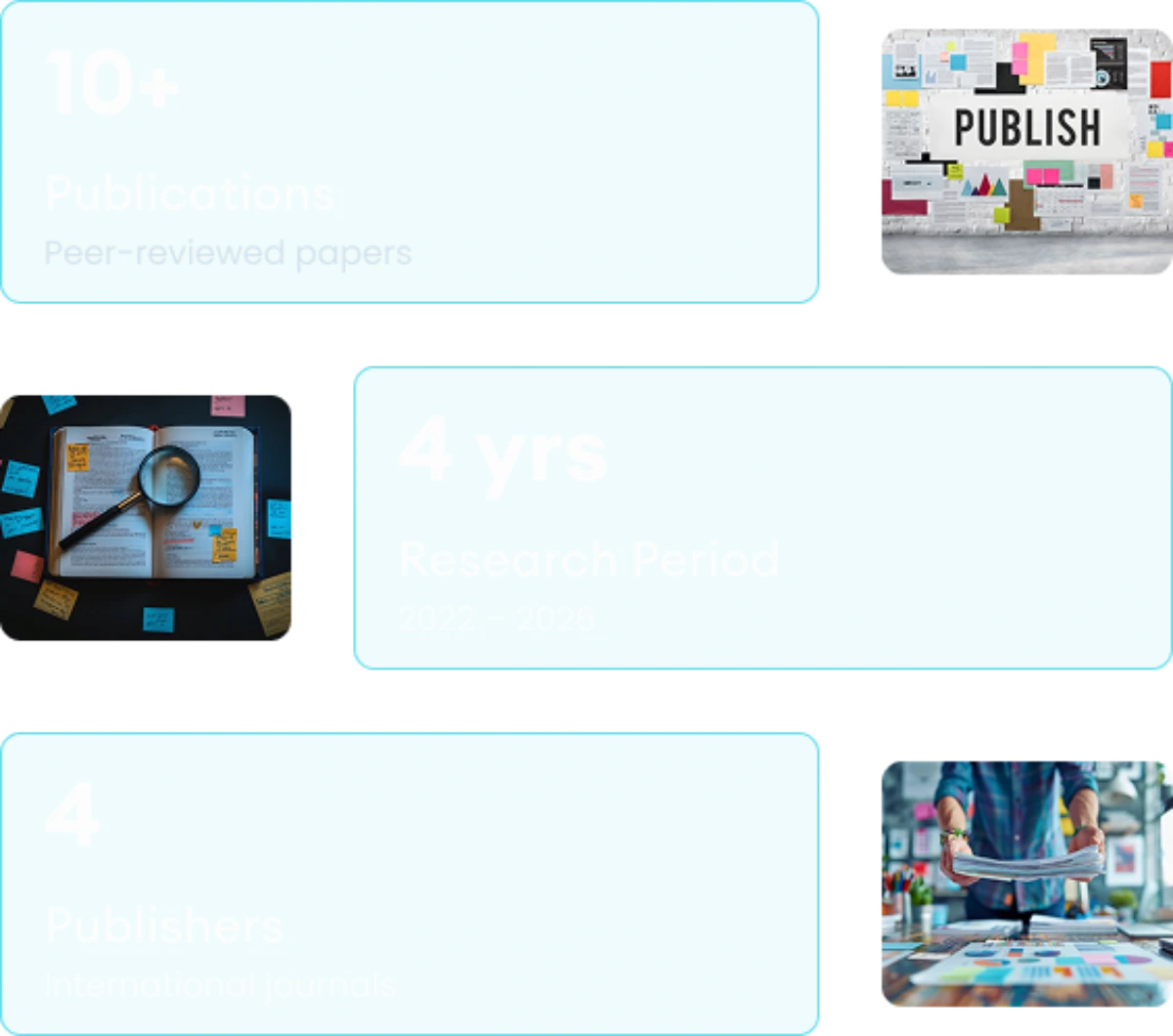
Between 2022 and 2026, research associated with e-KHOOL resulted in 10+ international publications in journals from World Scientific, Springer Nature, IOS Press, and SAGE Publications. These research outcomes directly support intelligent features such as personalised learning, AI-powered course recommendations, predictive learning analytics, and adaptive learning.