Governance
Define responsibilities, decision-making structures, approval workflows, committees, authorities, and accountability across the organization.
Manage regulatory requirements, policies, risks, controls, evidence, incidents, and audits from one connected platform. Maintain visibility across compliance activities and identify gaps before they become audit issues.
Manage ComplianceDefine responsibilities, decision-making structures, approval workflows, committees, authorities, and accountability across the organization.
Track applicable regulations, obligations, deadlines, and compliance requirements across business units, locations, and regulatory frameworks.
Create, review, approve, publish, and manage policies with version control, ownership, acknowledgement, and scheduled reviews.
Identify, assess, prioritize, and monitor organizational risks with clear ownership, mitigation actions, controls, and supporting evidence.
Bring requirements, policies, risks, responsibilities, and actions together so compliance teams always know what needs attention.
Define roles, responsibilities, authorities, committees, approval structures, and decision-making workflows across the organization.
1Track regulatory obligations and map them to business processes, departments, policies, controls, owners, and deadlines.
2Manage the complete policy lifecycle from creation and approval to publication, employee acknowledgement, review, and renewal.
3Maintain a centralized risk register with risk ratings, categories, owners, mitigation plans, review schedules, and current status.
4Know what is required, who owns it, and what needs to happen next
Create an Audit Evidence Vault where supporting documents and records are connected directly to requirements and controls.
Organize the evidence needed to demonstrate compliance across departments, locations, processes, and regulatory frameworks.
Link evidence directly to the controls, requirements, risks, policies, or audit requests they support.
Track expiry and renewal dates for certificates, licences, approvals, policies, and other time-sensitive records.
Give teams a real-time view of audit preparedness by identifying evidence coverage, missing documents, expired records, and unresolved gaps.
Certificates · Approvals · Contracts · Policies · Training Records · System Logs · Inspection Records · Compliance Reports
Find missing evidence before the auditor does
Connect regulations and compliance requirements to controls, responsible owners, supporting evidence, and current status.
Capture applicable regulations and translate them into specific organizational requirements.
Define the controls required to address each requirement and reduce associated risks.
Assign responsibility for each control with clear ownership, review schedules, and accountability.
Connect control owners with the documents, records, system logs, approvals, and other evidence required to demonstrate compliance.
Track control implementation, testing results, exceptions, remediation actions, and evidence coverage.
Make every compliance requirement traceable from regulation to evidence
Manage compliance incidents and audit findings from detection through investigation, corrective action, evidence collection, and closure.
Capture compliance incidents, control failures, audit findings, policy violations, and other issues in one centralized workflow.
Record incident details, investigation findings, contributing factors, affected processes, and responsible teams.
Identify the underlying cause of an issue and document the analysis required to prevent recurrence.
Create action plans with assigned owners, deadlines, priorities, dependencies, and required evidence.
Track corrective-action progress and require supporting evidence before an issue can be formally closed.
Move every compliance issue from detection to verified closure.
Give compliance teams and leadership a single view of compliance health, risks, controls, evidence, deadlines, and audit readiness.
Track key compliance metrics from one centralized dashboard
Bring critical compliance activities into one shared calendar:
Regulatory Filing → Licence Renewal → Policy Review → Risk Review → Control Testing → Internal Audit → External AuditReceive alerts for upcoming deadlines, expired evidence, overdue actions, policy reviews, control testing, and unresolved high-risk issues.
Give leadership a consolidated view of compliance performance, risk exposure, outstanding actions, and audit preparedness.
See your compliance position, upcoming obligations, and critical gaps at a glance
AIRA brings AI agents into your compliance operations to understand regulatory requirements, analyze risks, find evidence, review policies, track actions, and support audit readiness—using your organization’s available data, permissions, and workflows.
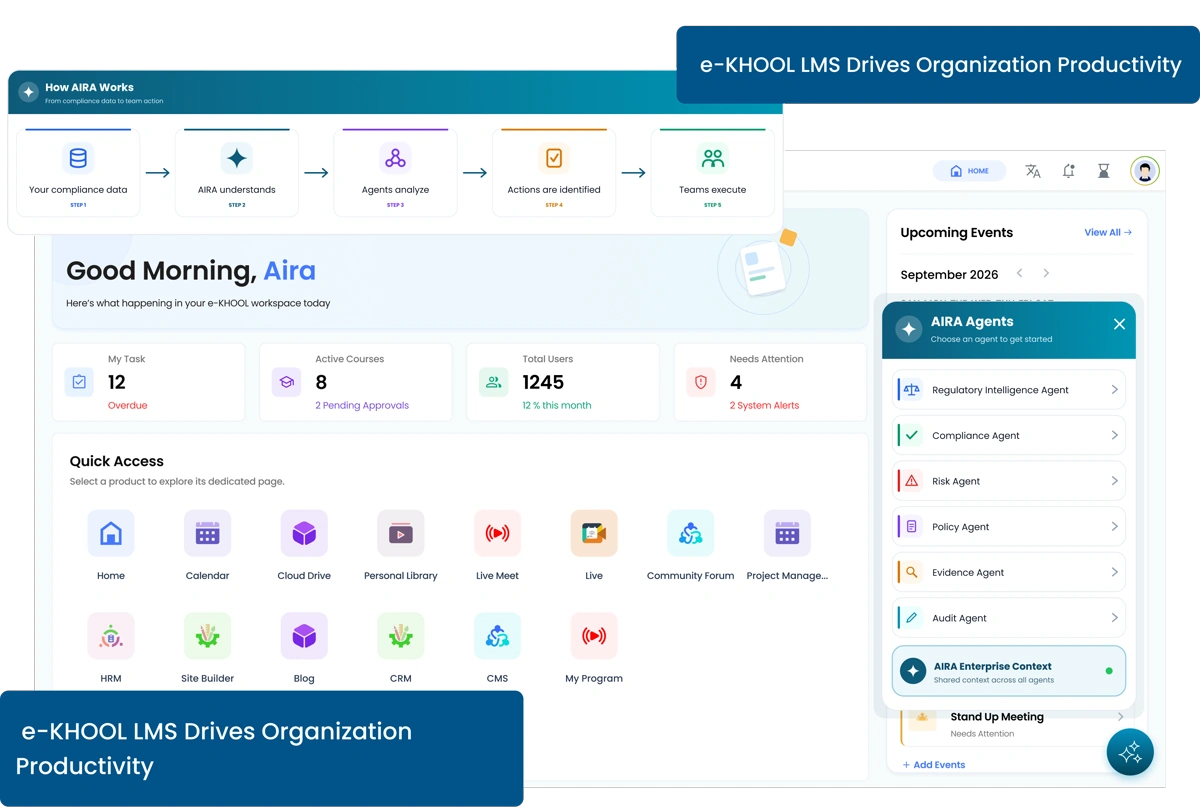
Ask AIRA compliance questions in natural language to identify overdue requirements, high-risk obligations, missing evidence, policy reviews, corrective actions, and audit-readiness gaps.
Identify relevant regulatory developments, analyze potential organizational impact, and surface requirements that may need attention.
Review compliance obligations, identify gaps, monitor deadlines, and summarize outstanding compliance actions.
Analyze risk exposure, surface high-risk areas, monitor mitigation activities, and highlight overdue risk actions.
Analyze policies, identify review requirements, and connect policies with applicable requirements, controls, and responsibilities.
Locate supporting evidence, identify missing or expiring records, and connect evidence with relevant requirements and controls.
Review control status, evidence coverage, open findings, and outstanding gaps to help teams prepare audit-readiness information and reports.
AIRA can work with organizational knowledge, compliance records, permissions, workflows, and contextual memory to provide responses based on the information available to each authorized user.
AIRA working across GRC operations
Connect governance, compliance, risk, controls, evidence, and corrective actions to reduce compliance gaps and improve organizational readiness.
Reduce time spent collecting documents, following up with owners, preparing reports, and maintaining compliance records.
Bring requirements, controls, evidence, findings, and corrective actions together to reduce the effort required to prepare for audits.
Connect regulations to requirements, controls, owners, evidence, testing, and status for complete compliance visibility.
Give teams structured workflows for investigation, corrective actions, ownership, deadlines, evidence, and closure.
Identify missing evidence, overdue actions, expired records, and control weaknesses before they become larger issues.
Give compliance teams, risk owners, managers, and leadership a shared view of compliance health and emerging risks.
Move from reactive compliance management to continuous organizational readiness
Connect compliance with identity, enterprise, learning, performance, document, communication, and workflow systems to create one connected compliance environment.
Assign mandatory compliance courses, track completion, manage certifications, and maintain training records against employees, requirements, and controls.
Connect compliance requirements with personalized learning, skill development, knowledge resources, and continuous employee learning journeys.
Link compliance responsibilities and development needs with goals, competencies, performance reviews, development plans, and career growth.
HRMS, ERP, CRM, document management, and business applications.
Connect internal applications, specialized systems, and client-specific workflows through APIs.
Compliance → Learning → Skills → Performance → Business ProcessesCreate a continuous connection between what employees must know, what they need to learn, what they can do, and how they perform.
Compliance Requirement → Learning → Skills → Performance → DevelopmentTurn compliance requirements into continuous employee development